

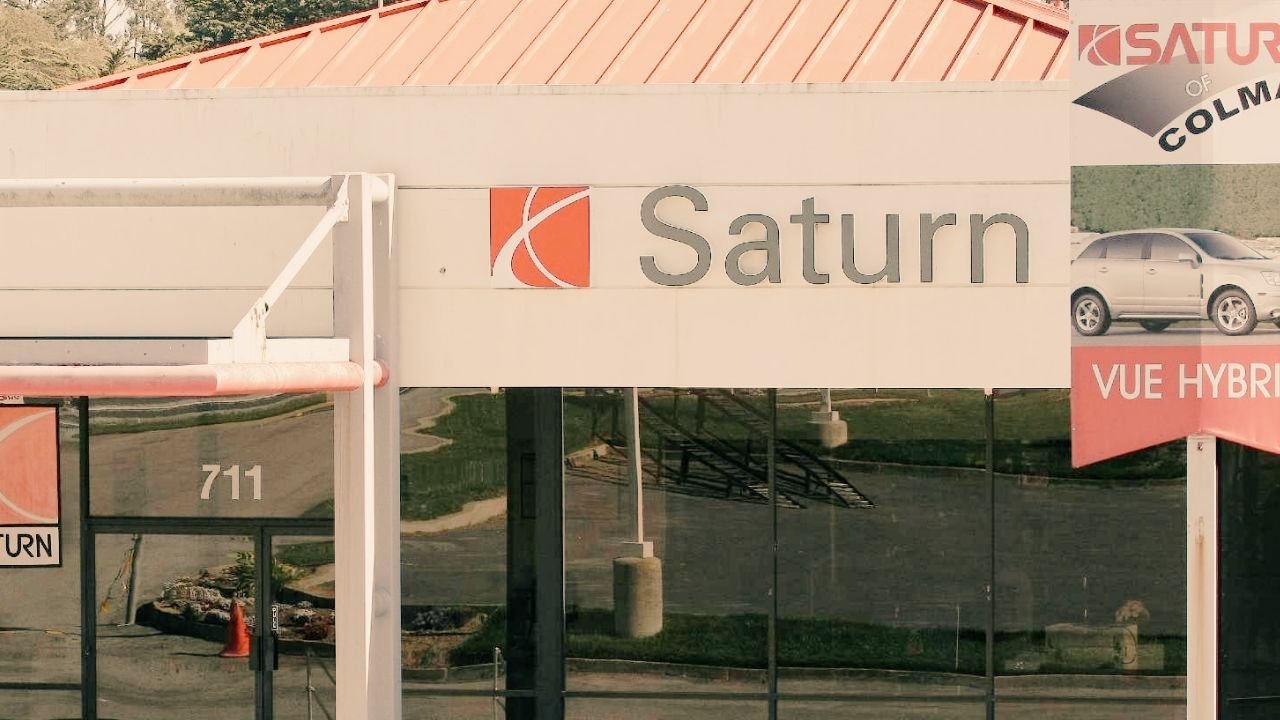
If you’ve seen a Saturn on the road recently, you might wonder whether the brand is still around. It’s a fair question. Older Saturns are still common enough that the brand feels present. But Saturn is gone — completely. It shut down over a decade ago and has no plans to return.
This article explains exactly what happened: when Saturn closed, why GM let it die, what the Penske deal was actually about, and what it all meant for owners, dealers, and GM’s recovery.
Saturn Is Already Gone — Here Is When It Ended
Saturn Corporation formally ceased operations by October 2010. The last Saturn vehicles rolled off the production line in 2009. No new Saturns have been built since then.
The brand sits in the same category as Pontiac and Oldsmobile — discontinued GM divisions that no longer exist in any operational form.
So why do people still ask? A few reasons. Older Saturns are durable enough to still be driving around. Some dealer signage lingered for years after the closure. And online articles about the Penske acquisition — an attempted buyout that fell apart — can make it seem like the situation was never fully resolved.
One more source of confusion: there are unrelated businesses using the Saturn name. Saturn Cars Ltd, a small used-car company based in the UK, has absolutely no connection to GM’s Saturn. They just share the name. If you’ve seen that company referenced online, it has nothing to do with the American car brand.
What Saturn Was and Why GM Created It
Saturn started as “Project Saturn” in the early 1980s. GM was losing ground to Japanese automakers — Toyota, Honda, and Nissan were taking real market share with affordable, reliable small cars. GM needed a response.
The answer was Saturn, incorporated in 1985 as a semi-independent subsidiary. It had its own manufacturing plant in Spring Hill, Tennessee, its own labor agreement, and its own identity separate from the rest of GM.
The brand launched with a clear pitch: a different kind of car company. No-haggle pricing, plastic body panels that resisted dents and rust, team-based manufacturing, and a dealer experience that actually tried to make customers feel comfortable rather than pressured.
For a while, it worked. Customer loyalty was genuinely strong. Saturn even held “homecoming” events where thousands of owners drove to the Spring Hill factory to celebrate the brand. That kind of connection between a car company and its customers was rare — and it was real.
Saturn stood apart from traditional GM divisions like Chevrolet and Buick throughout the late 1980s and most of the 1990s. It felt like its own thing, because for a while, it actually was.
How GM Gradually Undermined the Brand
Here is where Saturn’s story becomes a cautionary tale — not just for the auto industry, but for any business that tries to run an innovative unit inside a large, traditional organization.
Think of Saturn as an internal startup. Early independence gave it room to do things differently. But over time, GM’s corporate machinery took over. Investment slowed. Unique Saturn-specific models were replaced with rebadged versions of vehicles already sold under other GM brands. The thing that made Saturn different — its distinct identity — was slowly stripped away.
The costs of running a separate plant, separate platforms, and a separate dealer culture were high. Saturn’s margins were thin, sometimes negative. As Japanese and Korean competitors kept improving — offering strong reliability and value at competitive prices — Saturn’s original reason for existing became harder to defend.
By the time GM filed for bankruptcy in 2009, Saturn held roughly 1% of the U.S. auto market. That’s not a brand in decline — that’s a brand that had already been left behind.
The lesson here applies well beyond cars. When a company builds something genuinely different inside a large structure, then gradually standardizes it to save costs, the result is usually the worst of both worlds: too expensive to be efficient, too generic to be distinctive.
The Penske Deal That Almost Saved Saturn
When GM filed for Chapter 11 bankruptcy in June 2009, it had to make hard choices fast. The plan was to keep its four core brands — Chevrolet, Cadillac, Buick, and GMC — and shed everything else. Saturn, Pontiac, Hummer, and Saab were all put on the table.
For Saturn, there was a moment when it looked like survival was possible.
In June 2009, GM reached a tentative agreement to sell Saturn’s brand and its network of roughly 350 dealerships to Penske Automotive Group, the large dealership and automotive services company led by Roger Penske.
The plan had a practical structure. GM would continue manufacturing Saturn vehicles for approximately two years, giving Penske time to find a separate automaker to supply cars for the long term. The deal was expected to preserve around 13,000 jobs and keep the Saturn retail network running under new private ownership.
It was a real lifeline — not a done deal, but a credible path forward.
Then it fell apart.
Penske could not lock down a long-term manufacturing partner. Reports indicated that Renault’s board rejected a proposal to supply vehicles for the plan. Without a committed manufacturer to build Saturns beyond GM’s two-year window, the entire arrangement collapsed.
On September 30, 2009, Penske terminated the acquisition. The deal was dead.
What Happened After the Deal Collapsed
GM moved quickly. Within days of Penske walking away, GM announced it would wind down Saturn entirely. Production of new Saturn vehicles stopped in 2009. Dealership franchises were phased out through late 2010, with the brand fully discontinued by October 31, 2010.
For the roughly 350 Saturn dealers, the situation was difficult. Some transitioned to selling other GM brands. Some shifted entirely to used cars. Others closed. The collapse of the Penske deal put approximately 13,000 jobs at risk, according to Reuters reporting at the time.
For Saturn owners, the practical impact was less severe. GM directed customers to remaining Saturn dealerships while they stayed open, then to Chevrolet, Buick, and GMC dealers for service, warranty work, and parts. Owning a Saturn did not leave people stranded — it just meant no new models were coming, and resale values declined as the brand faded.
If you own a Saturn today, the aftermarket parts supply still exists. GM-authorized dealers can handle many repairs. It’s an older vehicle without manufacturer support, but it’s not unsupported entirely.
What Saturn’s Failure Tells Us About Business Strategy
Saturn’s story is worth understanding beyond the automotive details. A few clear business lessons stand out.
- Brand differentiation requires sustained investment. Saturn’s early identity was strong, but GM never committed to maintaining what made it different. Once the unique models were replaced with rebadged GM products, customers had no real reason to choose Saturn over a Chevrolet.
- Semi-independent units inside large companies face structural tension. Saturn had the culture of a startup and the costs of a separate operation. Over time, the parent company sought standardization, which undermined the innovation that justified the separate structure in the first place.
- Market share matters in triage decisions. When GM needed to cut, Saturn — sitting at 1% of the U.S. market — had no leverage. Brands that don’t build meaningful scale are always the first to go when a company needs to simplify.
The Penske attempt also shows something important: even when a viable buyer steps in, deals fall apart without a full supply chain in place. A retail and distribution network without a manufacturer behind it is not a car company.
For more analysis on how businesses handle brand strategy and corporate restructuring, New Business Desk covers these topics in practical detail.
Could Saturn Ever Come Back?
There is no indication that GM plans to revive Saturn. The brand name is owned by GM, but bringing it back would require real investment in new vehicles, a dealer network, and a reason for buyers to care — all from scratch.
GM has focused its resources on Chevrolet, Cadillac, Buick, and GMC, and more recently on its electric vehicle strategy. Saturn does not fit into that picture.
Brand revivals do happen occasionally in the auto industry, but they are rare and resource-intensive. For Saturn, the window closed a long time ago.
The Bottom Line
Saturn is not going out of business — it already went out of business. Production ended in 2009. The brand was fully phased out by October 2010. The attempted Penske acquisition was real, but it collapsed when no long-term vehicle supplier could be secured.
What Saturn leaves behind is a clear example of what happens when a company builds something genuinely different, then slowly abandons what made it work. The brand had real loyalty and real promise. It ran out of investment, relevance, and eventually time.
If you own a Saturn, you can still keep it running. If you’re a business reader, the story offers something more useful: a detailed look at how a bold idea can survive for decades without ever being fully supported — and what that costs in the end.
Also Read: