

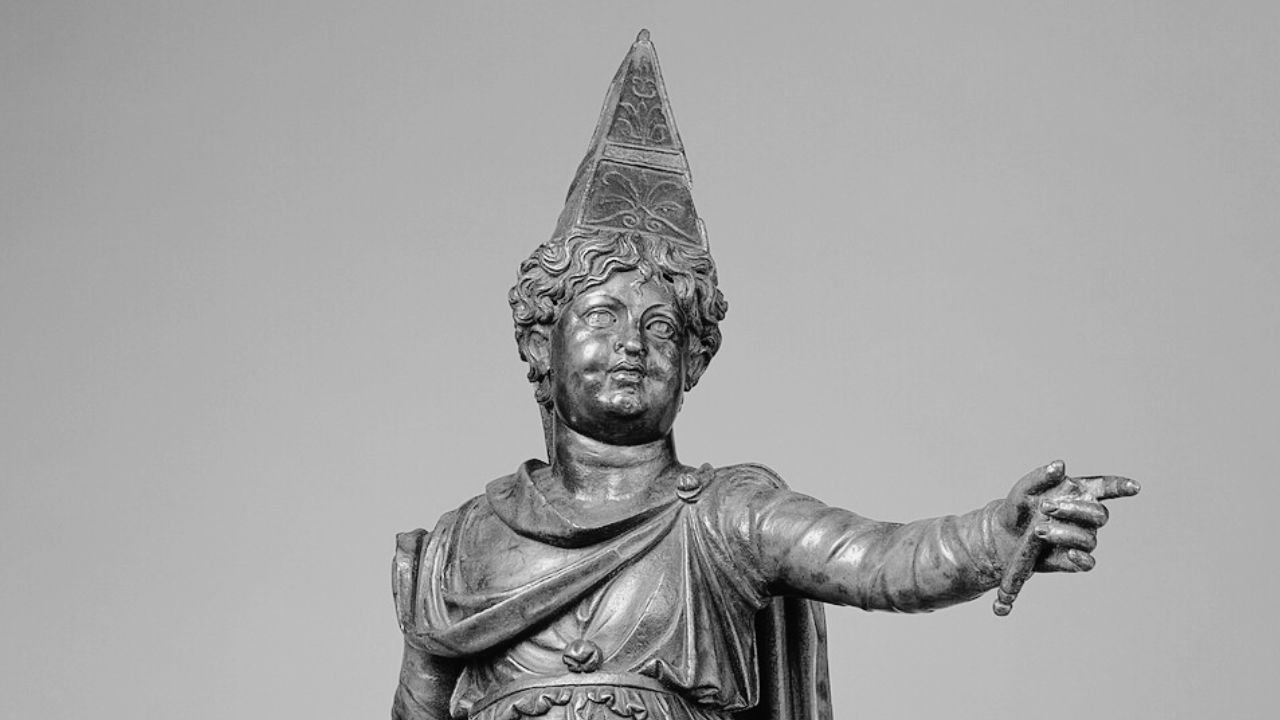
Few figures from the ancient world carry a name as symbolically loaded as Alexander Helios. He was a Ptolemaic prince named after the greatest conqueror in history and the sun itself. Yet despite his extraordinary origins, his life remains largely a mystery. Most people who search for his name are surprised to discover he was a real person — not a fictional character, not a modern public figure, but an ancient prince caught in the collapse of one of history’s most powerful dynasties.
This article covers who Alexander Helios was, what his name meant, the political ceremony that made him famous, what happened after Egypt fell to Rome, and why his fate is still uncertain today.
Who Was Alexander Helios?
Alexander Helios was an ancient Ptolemaic prince, born around 40 BCE in Alexandria, Egypt. He was the son of Cleopatra VII, the last active ruler of Ptolemaic Egypt, and Mark Antony, the powerful Roman triumvir. He was not a modern celebrity, a fictional character, or a mythological figure. He was a real child born into one of the most politically charged families of the ancient world.
Alexander had a fraternal twin sister named Cleopatra Selene II. The two were born together and shared a deeply symbolic pairing, as their names suggest. He also had a younger full brother, Ptolemy Philadelphus, also fathered by Antony.
His older half-brother was Caesarion, Cleopatra‘s son by Julius Caesar. Caesarion was considered Cleopatra’s heir and carried enormous political significance as the son of Caesar. Alexander Helios occupied a different but still important place within this royal family structure.
The Meaning Behind His Name
The name Alexander Helios was not chosen randomly. Every part of it carried political and symbolic weight.
“Alexander” was a direct reference to Alexander the Great, the Macedonian conqueror who built one of the largest empires the ancient world had ever seen. For a Greek-speaking royal family like the Ptolemies, there was no more powerful name to give a son. It immediately connected the child to conquest, ambition, and legacy.
“Helios” is the Greek word for “Sun.” His twin sister’s name, Selene, means “Moon.” That pairing was entirely deliberate. Together, the twins represented complementary forces — the Sun and the Moon — which positioned them as symbols of royal and cosmic power.
This was dynastic branding. Cleopatra and Antony were presenting their children as heirs to something much larger than a single kingdom. The names themselves were part of that message.
The Donations of Alexandria and His Royal Titles
In 34 BCE, Antony and Cleopatra staged a grand public ceremony in Alexandria. It is known historically as the Donations of Alexandria. During this event, the couple publicly assigned royal titles and territorial claims to their children.
Alexander Helios was proclaimed the intended ruler of Armenia, Media, Parthia, and territories said to extend toward India. These were sweeping, impressive-sounding claims. It is important to understand, though, that they were largely political and aspirational rather than a record of lands he actually governed.
Alexander was still a young child. The ceremony functioned more as a dynastic program and a public statement of ambition than an actual transfer of administrative power. He did not march armies or sit on thrones in Parthia. The titles were meant to signal what Antony and Cleopatra envisioned for their family’s future.
The event did have real consequences, however. It significantly intensified the conflict between Antony and Octavian, the future emperor Augustus. Octavian used the ceremony as political ammunition, portraying Antony as a man who had abandoned Roman values in favor of an Eastern monarchy. That tension eventually led to open war.
The Fall of Cleopatra’s Kingdom and What Came Next
The conflict between Antony and Octavian reached its decisive moment in 31 BCE at the Battle of Actium. Octavian won. Both Antony and Cleopatra died in 30 BCE, and Egypt became a Roman province. The Ptolemaic dynasty, which had ruled Egypt for nearly three centuries, was finished.
Alexander Helios, his twin sister Cleopatra Selene II, and their younger brother Ptolemy Philadelphus were taken to Rome. They were children when this happened — Alexander and his sister were around nine or ten years old.
The three children were displayed during Octavian’s triumphal procession in Rome, a traditional Roman ceremony celebrating military victory. For the Roman public, seeing Cleopatra’s children in chains was a powerful symbol of conquest. For the children themselves, it must have been a very different experience.
After the triumph, ancient-history accounts place the children in the household of Octavia Minor, Antony’s former Roman wife and Octavian’s sister. It is worth noting the unusual circumstance here: the children of Antony’s relationship with Cleopatra were placed in the care of the woman Antony had left behind to pursue that relationship. Octavia, by most historical accounts, raised them regardless.
Why Alexander Helios Disappears From the Historical Record?
After his arrival in Rome, Alexander Helios effectively vanishes from surviving historical sources. There is no confirmed record of his death, no account of a marriage, no known children, and no documented later life.
Some historians estimate he may have died sometime between roughly 29 and 25 BCE, but that remains uncertain. No ancient source clearly describes what happened to him. He simply stops appearing in the written record.
This is in sharp contrast to his twin sister, Cleopatra Selene II, whose story is much better documented. She survived Rome, later married Juba II of Mauretania, and became a client queen. She helped establish a lasting royal line in North Africa. Her political and dynastic career is relatively clear compared to her brother’s abrupt disappearance from history.
Some readers come across Alexander Helios through online genealogy databases. It is worth being careful with those entries. While they can accurately reflect historical parentage — confirming that his mother was Cleopatra VII and his father was Mark Antony — they cannot reliably establish an unbroken line of descent to any modern person. Alexander left no known children, and no securely documented dynasty traces back to him. User-submitted family trees on sites like Geni or MyHeritage are useful starting points, but they are not independent historical proof.
For readers interested in this period of ancient history, resources like Newbusinessdesk also cover how ancient dynasties and powerful family structures shaped history in ways that still capture public interest today.
Why He Still Matters?
Alexander Helios represents something genuinely fascinating about the ancient world. He stood at the intersection of Ptolemaic Egypt, Roman politics, and dynastic ambition. His name alone connected him to Alexander the Great, the sun in the sky, and a vision of royal power that stretched from Egypt to the edges of the known world.
And yet, after the fall of his family’s kingdom, he left almost no trace.
His story is a reminder that history tends to record the powerful and the survivors. His sister survived and ruled. His half-brother Caesarion was considered too dangerous to leave alive and was killed on Octavian’s orders. Alexander Helios fell somewhere in between — taken to Rome, displayed as a symbol of conquest, and then quietly lost to history.
What happened to him is not known. What is known is that he was a real child, born into extraordinary circumstances, given an extraordinary name, and caught in events far larger than himself. That, in its own way, is worth remembering.
Also Read: